The international Grawemeyer Awards in education, improving world order, music, psychology and religion valued at $200,000 each, originated in 1984.
UofL Grawemeyer Awards - About Grawemeyer
History
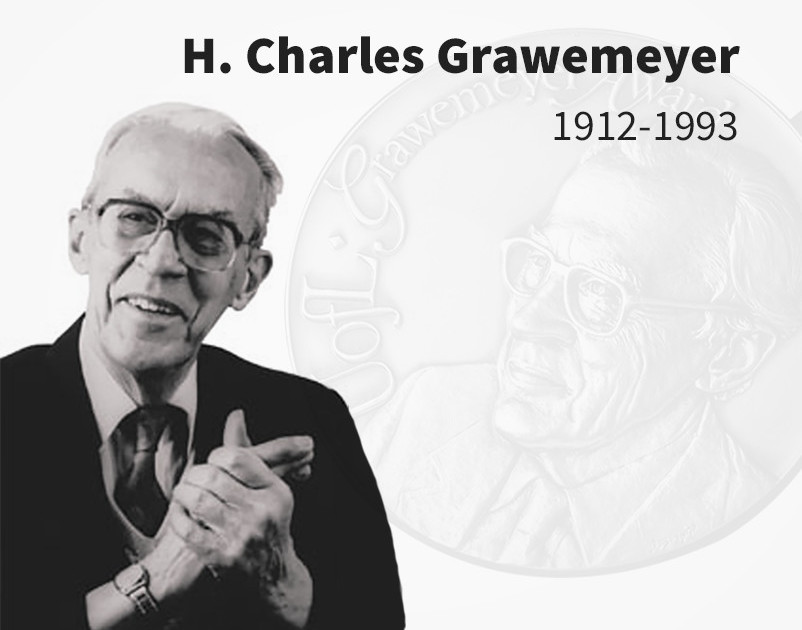
H. Charles Grawemeyer, industrialist, entrepreneur, astute investor, and philanthropist,
created the lucrative Grawemeyer Awards at the University of Louisville in 1984.
An initial endowment of $9 million from the Grawemeyer Foundation funded the
prestigious awards, which have drawn nominations from around the world since
their inception. Though a University of Louisville chemical engineer by schooling,
Mr. Grawemeyer cherished the liberal arts and chose to honor powerful ideas in
five fields in performing arts, the humanities, and the social sciences. The
first annual award, Music Composition, was presented in 1985. The award for Ideas
for Improving World Order was added in 1988 and Education in 1989. In 1990, a
fourth award, Religion, was added as a joint prize with the Louisville Presbyterian
Theological Seminary. Psychology was added in 2000, with the first award to be
given in 2001. The initial awards were for $150,000 each, making them among the
most lucrative in their respective fields. The Grawemeyer Awards increased to
$200,000 for the year 2000 awards. Between 1985 and 2000, more than $7 million
was awarded to 47 winners. Mr. Grawemeyer distinguished the awards by honoring
ideas rather than life-long or publicized personal achievement. He also insisted
that the selection process for each of the five awards--though dominated by professionals-include
one step involving a lay committee knowledgeable in each field. As Mr. Grawemeyer
saw it, great ideas should be understandable to someone with general knowledge
and not be the private treasure of academics.Charles Grawemeyer Biography
H. Charles Grawemeyer 1912-1993 Charles Grawemeyer was born in Louisville, Ky.,
in 1912 to immigrant German parents. He was one of seven children. His keen investment
sense and entrepreneurial spirit shone early. As a 12-year-old, he bought chickens
and sold their eggs to neighbors; he convinced other neighbors to sub-lease unused
garage space, which he then rented to people needing storage room. The enterprise
earned enough for young Grawemeyer to have a garage built for his parents. He
also sub-leased this space. Charles Grawemeyer was a diligent, hard-working high
school student bent on traveling east for an engineering degree. The Great Depression
sunk his plans. So he chose the affordable, close-to-home option of attending
the University of Louisville's Speed Scientific School, where he biked to school,
unable to afford bus fare. He graduated in 1934. In his junior year, he met his
wife, Lucy, on a blind date. They were married for 57 years and had three daughters.
During that same junior year, he started as a co-op student at a local company,
Reliance Paint and Varnish Company. The firm eventually became Reliance Universal,
an international coatings company. Charles Grawemeyer advanced from co-op to
chairman in a 40-year career at Reliance. In 1967, he retired from the company
and the following year founded his own venture, Plastic Parts, Inc., in nearby,
rural Shelbyville, Ky. Throughout his life, Charles Grawemeyer was known for
asking penetrating questions and for never raising his voice. He was a devoted
husband and father, a Presbyterian active in church affairs, and a lover of music,
books, art and travel. A quiet man, unassuming by nature, he has been described
as being remarkable by trying to be unremarkable. His funeral, on December 11,
1993, provided the final glimpse of this remarkably unselfish man. It was populated
by Louisville business, civic, church and education leaders-and by weathered
farmers in broad brimmed hats all whom he had befriended over his lifetime. Then
U of L President Donald Swain spoke to the assemblage about Charlie Grawemeyer's
awards: "To a remarkable extent, he put his personal stamp on the awards, which
surely are his shining legacy. They are devoted to the beauty of creativity and
the power of great ideas to change the world. The awards incorporate his simple
conviction that the judgment of lay persons-not academic experts-ought to be
decisive in the selection of award winners. From this day forward, we will honor
his memory by doing what he wanted us to do most of all: exalt the life of the
mind, consider great ideas, reward creativeness."
UofL Grawemeyer Awards - Grawemeyer Winners
Current Winners
Check here to see the latest winner in each Grawemeyer Award category. Read more
about the winners and listen to or read a sample of the winning entry. It should
also be noted that there is no requirement for any Grawemeyer Award to be given
every year.
Previous Winners
Since 1985, the University of Louisville Grawemeyer Awards have recognized individuals
and teams from all over the world for their innovative ideas. This archive will
allow you to view past winners in any of the five categories, read a description
of their work and review an explanation of why they were chosen.
UofL Grawemeyer Awards - Grawemeyer Categories
Categories
Education Improving World Order Music Psychology Religion
UofL Grawemeyer Awards - Education
Background
UofL Grawemeyer Awards - Improving World Order
Background
Professors of political science Paul Weber and Landis Jones, who had both taught
Mr. Grawemeyer in his retirement years, met with Charles Grawemeyer hoping he
wanted to create an award in political science. They were optimistic but puzzled.
They had taught him radically different courses but thought of him as a provocative
and thoughtful student. He did everything the young students did except take
the exams. He even bought all the books and, when finished, gave them to the
professors to pass on to deserving students the following semester. In their
meeting, Mr. Grawemeyer got to the point, Weber recalled. He wanted to fund a
prize in international political science, "something like the Nobel, only better."
Mr.Grawemeyer had studied the Nobel and saw its value for recognizing people
who have done something. "Who can be like Martin Luther King or Mother Teresa?"
Weber recalled Grawemeyer pondering. It was clear Grawemeyer liked ideas that
might make a difference. According to Weber, Grawemeyer told them, "Peace is
a good idea, but it's too narrow. We need justice, too, and well ordered societies
all across the world. I'd like to reward ideas that get us closer to that." The
first Grawemeyer Award for Ideas for Improving World Order was shared, in 1988,
by two Harvard professors: Richard Neustadt and Ernest May. Their work, Thinking
In Time: The Uses of History for Decision-Making, uses 30 case studies to challenge
political decision makers to use their experiences and those of hundreds of historic
figures, in disciplined thought patterns, to govern, manage, and exercise authority.
UofL Grawemeyer Awards - Music Composition
Background
In 1983, Charles Grawemeyer met with Dr. Jerry Ball dean of the University of
Louisville School of Music to discuss establishing a prize in music, but Mr.
Grawemeyer wasn't sure what it should honor. So they talked and settled on composition,
with Mr. Grawemeyer concluding, according to Dr. Ball, "If we did something like
this perhaps we could find another Mozart." Music composition became the first
of the five Grawemeyer award categories. Being first, it took almost two years
to work out all the details of the program. The Nobel process was studied and
incorporated in part. But Mr. Grawemeyer wanted what he termed a more "democratic"
judging, eventually involving three levels: the U of L music faculty, an international
jury of professionals, and a lay (non-professional, but knowledgeable) panel.
In 1985, the first Grawemeyer Award in Music Composition went to Witold Lutoslawski,
a Polish composer, for his Symphony #3. Since then the Grawemeyer Award has achieved
international recognition as the premier music composition award, regularly attracting
between 150 and 200 entries annually from around the world. "Charlie Grawemeyer
could have gone to any school in the country, to any orchestra, any opera company,
any place he might want to go to offer this prize. It's wonderful that he kept
it at home and honored his university," said Ball.
UofL Grawemeyer Awards - Religion
Background
Charles Grawemeyer was an active Presbyterian and a man who took the study of
religious ideas seriously. In fact, he took university religion courses during
his retirement, making his inclusion of an award for religion only natural. Dr.
John Mulder, president of the Louisville Presbyterian Theological Seminary, recounted
the day in 1984 when Mr. Grawemeyer invited him to lunch, and simply said: "John,
you know the music award won't be the only one. I'd like to create a prize in
education, world order, and religion. I want the seminary to be part of the religion
award." The Grawemeyer Foundation, the University of Louisville and the Louisville
Presbyterian Theological Seminary promptly began to shape the prize. Natural
hurdles arose, and many questions surfaced. "What is an award in religion about?"
"Is it simply Christian faith, or does it include other traditions from peoples
around the world?" Even more contentious: "Should the work be more 'popular"
and less 'academic'?" "Should it be inspirational or should it promote questioning
or honor revisionary proposals?" These and other issues were resolved and guidelines
were set, including a provision that the selection committee would include at
least one person of non-Christian faith and someone from outside North America
or with extensive experience outside North America. The first award was presented
in 1990 to E.P. Sanders for his provocative book, Jesus and Judaism, a painstaking
look at Jesus' relationship with his Jewish contemporaries.
UofL Grawemeyer Awards - Psychology
Background
The Grawemeyer Foundation, housed at the University of Louisville, has added
psychology to its already distinguished list of awards categories. 2001 will
mark the first year the Louisville Grawemeyer Award for Psychology will be given.
The judges have been assembled and nominations are being accepted from every
field of psychology for this prestigious award. The $200,000 Grawemeyer award
will recognize outstanding ideas in all areas of the discipline. Nominations
will be judged on the basis of originality, creativity, scientific merit, and
scope of potential applicability in the field of psychology. Dr. Joseph F. Aponte
directs the Grawemeyer Psychology Committee that will conduct the nomination
and awards process. Other committee members include Dr. Michael R. Cunningham,
Zijiang He, and Dr. Carolyn B. Mervis from the University of Louisville Department
of Psychological and Brain Sciences, and Dr. Terry Singer, Dean of the Kent School
of Social Work at the University of Louisville. Charles Grawemeyer, an industrialist,
engineer and entrepreneur from Louisville, Ky. had a life-long passion for music,
education, and religious studies. Consequently, he chose to honor ideas in the
arts and the humanities. Rather than rewarding recent or lifetime personal achievements,
Grawemeyer wanted to recognize single powerful ideas or creative works.
UofL Grawemeyer Awards - News and Updates
Contact: John Drees (502-852-6171) John.Drees@louisville.edu Grawemeyer Awards
Increased to $200,000 Winners for 2000 to Be Announced November 1999 Nominations
for music composition exceed 2001 Psychology added as field of interest for 2001
LOUISVILLE, Ky. (June 28, 1999) -- The first major international awards to honor
powerful ideas rather than achievement have just become more lucrative. The next
recipients of the prized Grawemeyer awards in music composition, religion, education
and ideas improving world order will receive $200,000 each, up from the $150,000
given since the inception of the awards in 1985. The increase makes the awards,
established by the late industrialist Charles Grawemeyer to honor ideas and creativity,
the most valuable in their disciplines. Past recipients have included Mikhail
Gorbachev, winner of the 1994 ideas improving world order award for his 1988
address to the United Nations, Charles Marsh, author of "God's Long Summer: Stories
of Faith and Civil Rights" and winner of the 1998 award in religion, and John
Corigliano who won the 1991 music composition award for the score he wrote for
the movie "The Red Violin," which opened in theatres this summer. The nomination
process for the year 2000 awards has just concluded, yielding more than 300 entries
in the four Grawemeyer categories. The Grawemeyer award for music composition,
established in 1985 as the first of the awards, is the best known and received
the most nominations for the year 2000. Of the 210 music compositions, 90 were
from outside the United States, led by the United Kingdom with 24 and followed
by Germany (11) and France (10). The 110 nominations within the United States
came from 27 states and Washington, D.C. New York led with 35, followed by California
(12) and Massachusetts (11). Three other Grawemeyer awards generated nominations
from around the world. Ideas Improving World Order (International Affairs), established
in 1988, received 46 nominations from 16 states, Washington, D.C, Canada and
one each from England, France, Italy and Russia. Education, established in 1989,
received 31 nominations from 13 states, Canada, England, France (2), India and
South Africa (2). Religion, established in 1990, received 19 nominations from
10 states, Canada (2), England, Germany (2), Japan and South Africa. The selection
process is conducted in three phases. A jury of professionals from each discipline
evaluates between eight and 14 semifinalists from the total field of nominees
in their category. A knowledgeable lay panel from each discipline then reviews
the works of the three finalists selected by the professional jurors. In setting
up the award criteria, Grawemeyer insisted that this lay panel be an intricate
part in choosing the winners. As he saw it, "Ideas should not be the private
treasure of academics." Finally, a panel led by University of Louisville President
John Shumaker reviews and approves the final selection. The Grawemeyer Foundation
has added a final award in psychology to be given for the first time in 2001.
Calls for nominations for the five 2001 awards will occur during the summer and
fall of 1999. The year 2000 Grawemeyer Award winners will be announced in November
1999 and will be presented with the Grawemeyer medallion in March of 2000. Grawemeyer,
an industrialist, engineer and entrepreneur from Louisville, Ky., had a life-long
passion for music, education and religious studies. Consequently, he chose to
honor ideas in the arts and the humanities. Rather than rewarding recent or lifetime
personal achievements, Grawemeyer wanted to recognize powerful ideas or creative
works. The Grawemeyer Foundation is housed at the University of Louisville. The
awards for music composition, ideas improving world order, education and psychology
are presented by the University and the Grawemeyer Foundation. The University,
the Grawemeyer Foundation and the Louisville Presbyterian Theological Seminary
give the religion award.
UofL Grawemeyer Awards - Contact Information
Contact Information
-E-mail, name, phone, address Category Contacts - E-mail Form Education Improving
World Order Music Psychology Religion
UofL Grawemeyer Awards - Lnks
Links
University of Louisville Louisville Presbyterian Theological Seminary The United
Nations Nobel Prize Peabody Templeton MacArthur Pulitizer